
Pneumatic and Vacuum Home Elevators in UAE: How They Work

Vacuum home elevators in UAE have moved from a novelty feature to a genuine mainstream option for villa owners – largely because they solve the one problem that stops most homeowners from installing a lift at all: major structural work. Here’s how the technology actually works, what it costs, and how it compares to the hydraulic systems most people default to first.
What Is a Vacuum Home Elevator?
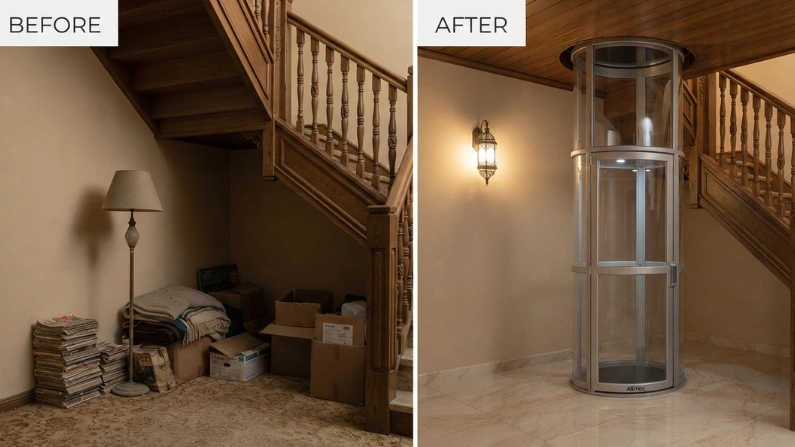
A vacuum home elevator – also called a pneumatic elevator – moves a cabin up and down inside a sealed, transparent cylindrical shaft using controlled air pressure, rather than cables, counterweights, or hydraulic fluid. There’s no pit to excavate, no separate machine room, and in most cases, no dedicated shaft construction – the cylinder itself is the structure.
How Vacuum Home Elevators in UAE Actually Work
The mechanics are simpler than most people expect, and understanding the sequence explains why the technology behaves so differently from a traditional lift:
- Sealed cylinder shaft – airtight, transparent tube (typically polycarbonate or aluminum) houses the cabin from base to top floor
- Vacuum pump activates – a turbine at the top of the cylinder reduces air pressure above the cabin
- Atmospheric pressure lifts the car – with less pressure above than below, the cabin rises smoothly upward
- Controlled descent by gravity – to lower the cabin, air pressure is gradually reintroduced above it, allowing a slow, controlled descent rather than a powered one
- Cabin arrives and levels automatically – sensors confirm floor alignment before the doors unlock
Because descent relies on gravity rather than a motor, a vacuum home elevator only draws power on the way up – a real, mechanical reason behind the energy-efficiency claims most suppliers make, not just marketing language.
Vacuum Lift vs Hydraulic Lift - What's Actually Different
Homeowners comparing options usually default to hydraulic systems simply because they’re more familiar, but the two technologies solve different problems:
| Factor | Vacuum Lift | Hydraulic Lift |
| Pit required | No | Yes, typically |
| Machine room | No | Often yes |
| Moving parts | Fewer – no cables, counterweights, or oil | More – pump, cylinder, hydraulic fluid |
| Maintenance | Lower, fewer components to service | Higher, oil and pump servicing required |
| Best suited for | Retrofit projects, villas with limited structural flexibility | New builds where pit/machine room space is already planned |
| Typical capacity | 1 – 4 persons | Higher capacity, suited to heavier daily use |
A vacuum lift vs hydraulic lift decision usually comes down to one question: is this a retrofit existing villa lift, or a new build where structural planning happens from day one? Retrofits favor vacuum systems almost every time, simply because there’s no shaft or pit to build into an already-finished home.
Vacuum Elevator vs MRL Lift
|
Factor |
Vacuum Elevator |
MRL Lift |
|
Technology |
Uses air pressure to move the cabin |
Uses a traction motor, ropes and counterweight |
|
Installation |
Minimal structural work; no conventional pit or machine room |
Requires more planning for shaft, pit and lift structure |
|
Best for |
Existing villas and retrofit projects |
New villas and buildings with higher usage |
|
Capacity |
Generally suited to lighter residential use |
Available in higher-capacity configurations |
|
Design |
Transparent, panoramic and space-efficient |
Conventional cabin design with wider customization |
|
Energy Use |
Uses power mainly during upward travel |
Motor-powered movement in both directions |
|
Maintenance |
Fewer mechanical components |
Requires maintenance of motor, ropes and traction components |
|
Ideal Choice |
When quick installation and minimal civil work are priorities |
When frequent use, capacity and conventional lift performance matter |
Pneumatic Vacuum Elevator Cost in UAE - What Drives the Price
Pneumatic vacuum elevator cost in UAE typically falls in the range of AED 100,000 to AED 200,000, though the final figure depends heavily on a handful of specific factors rather than being a flat rate:
Number of stops
A 2-stop configuration costs meaningfully less than a 3- or 4-stop system
Cabin capacity
Single-passenger models sit at the lower end; wheelchair-accessible and multi-passenger configurations cost more
Finish and customization
Glass tint, cabin color, premium lighting, and control panel upgrades all add to the base price
Site conditions
Even without a pit or machine room, unusual floor layouts or access constraints can affect installation complexity
Residential Vacuum Elevator Cost in UAE - Beyond the Unit Price
Residential vacuum elevator cost in UAE isn’t just the lift itself – homeowners budgeting for a villa installation should account for the full picture:
- Installation labor – typically completed in 2–5 days given the minimal civil work involved
- Electrical connection – most vacuum systems run on standard single-phase power, keeping this cost relatively low compared to three-phase traction systems
- Annual maintenance – lower than hydraulic systems due to fewer moving parts, though periodic servicing is still recommended
- Permits and approvals – even structurally simple installations typically require sign-off from local authorities before commissioning
Getting a single number without these details attached is rarely useful – a homeowner comparing quotes should ask what’s included and what’s quoted separately before assuming one supplier is cheaper than another.
Why Vacuum Elevators Suit UAE Villas Specifically
Several factors make this technology a particularly strong fit for the UAE residential market rather than just a general trend:
Retrofit-friendly
The majority of UAE villas weren’t originally designed with a lift shaft, making no-pit, no-machine-room installation genuinely valuable rather than a nice-to-have
Architectural statement
The transparent cylinder design suits the open, modern interiors common in newer UAE villa developments
Smart home compatibility
Many systems now integrate with app-based and voice controls, aligning with broader smart-villa adoption across Dubai and Abu Dhabi
Safety Features to Look For
Not every vacuum elevator on the market is built to the same standard, and residential lift safety features vary meaningfully between suppliers:
- Emergency descent system – automatically lowers the cabin safely in the event of a power outage
- Pressure sensors and automatic braking – regulate speed and prevent uncontrolled movement
- Sealed cabin construction – airtight design is what makes the lifting mechanism work, but it also needs to be verified for structural integrity, not just aesthetics
- Compliance documentation – ask for certification records rather than accepting a verbal safety claim
Conclusion
There’s no universally “better” option – it depends on your villa’s structure and how the elevator will be used day to day. Vacuum systems suit retrofit projects, lighter daily use, and homes where preserving the existing structure matters. Traditional hydraulic or traction elevators suit new-build projects where higher capacity or continuous heavy use is expected. For a broader look at home elevator options in the UAE beyond vacuum technology specifically, Altivex’s full home elevator range covers hydraulic, traction, and custom villa lift configurations alongside pneumatic systems.
FAQ
How much space does a vacuum home elevator need?
Vacuum elevators typically require a compact footprint of roughly 1 meter in diameter, since the airtight cylinder itself serves as both the shaft and the structural support – no separate shaft construction is needed.
Is a vacuum elevator safe during a power outage?
Yes. Since descent relies on gravity and controlled air pressure rather than a motor, most vacuum elevators include an automatic emergency descent function that safely lowers the cabin even without power.
Can a vacuum elevator be installed in an existing villa without major renovation?
Yes. This is the primary reason vacuum elevators are popular for UAE retrofit projects – no pit, shaft, or machine room construction is typically required, minimizing disruption to a finished home.
How does a vacuum lift compare to a hydraulic lift for daily use?
Vacuum lifts suit lighter, more occasional use with lower maintenance needs, while hydraulic systems handle higher capacity and more frequent daily traffic, making the right choice dependent on household usage patterns.
How long does installation typically take?
Most vacuum home elevator installations are completed within 2 to 5 days, significantly faster than traditional lift systems that require pit excavation and machine room construction.
Our Services
Elevator Manufacturing | Elevator Supply | Elevator Installation
Ready to Install Our Elevators?
Book a free consultation with Altivex today!
Our Specialities!
Trusted world wide| Free Installation | EU Standards | 5-Year Warranty | Fast 14-Day Delivery — Suitable for Residential, Commercial & Industrial Applications