
Escalator for Grocery Cart in UAE: A Specification Guide for Designers and Building Owners
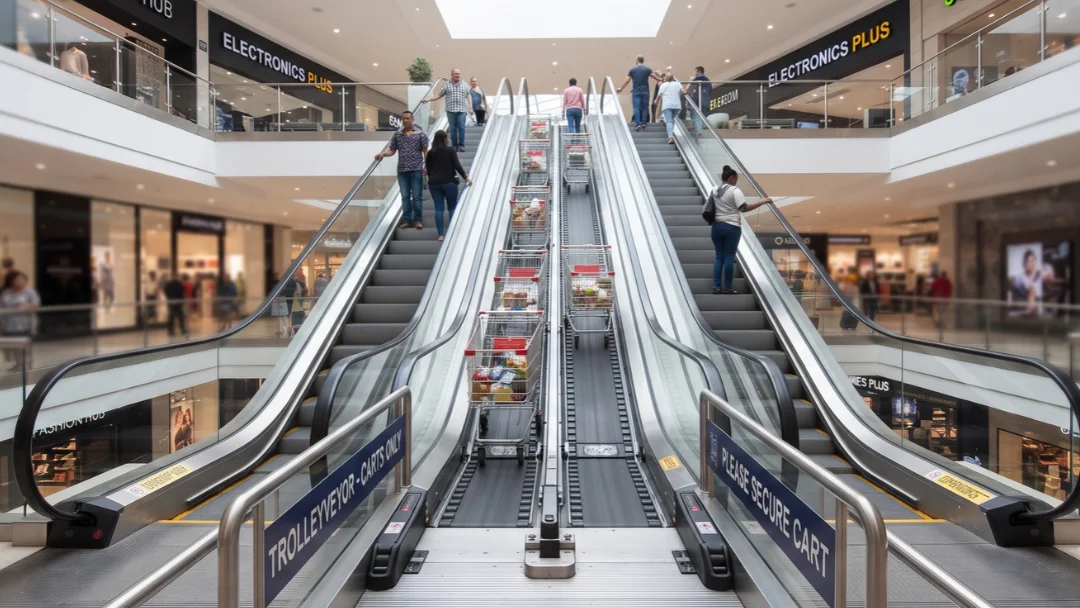
Multi-level supermarkets and shopping malls across the UAE face a specific design problem: how do you move customers and loaded grocery carts between floors safely, without forcing shoppers to abandon their trolleys at the escalator or squeeze into an undersized freight lift? An escalator for grocery cart in UAE retail projects solves this directly – and getting the specification right matters more at the design stage than almost any other equipment decision in a multi-level retail layout.
What Is a Shopping Cart Escalator?
A shopping cart escalator is a purpose-built inclined transport system engineered to carry customers and loaded grocery trolleys together, rather than requiring separate freight elevators for cart movement. Unlike a standard passenger escalator, the steps and drive system are designed specifically to hold a wheeled cart securely in place during the incline, so shoppers can travel between floors without unloading or navigating around their trolley.
How a Shopping Trolley Escalator Works
The mechanism behind a shopping trolley escalator is more specific than most designers expect. Cart wheels are manufactured with a groove running through the center, engineered to interlock with the rungs on the escalator’s stepped surface.
As the cart is pushed onto the moving incline, that groove seats into the rungs, and friction from the step’s rubber tread holds the wheel in place for the full ride – no separate locking mechanism required. The incline itself typically runs at a 30° to 35° angle, shallower than needed for pure pedestrian traffic, to keep the cart stable throughout the ascent or descent.
Safety Features a Supermarket Escalator Must Include
A supermarket escalator carrying loaded carts alongside pedestrians needs safety engineering beyond a standard passenger unit, and this is where specification decisions matter most for building owners and safety consultants:
Entrance swing gate with cart detection
Controls cart entry timing so carts enter the incline at the correct interval, preventing collisions at the boarding point
High limit bar at entry
Physically prevents over-stacked or oversized carts from entering the escalator, reducing tip-over risk
Reinforced stainless steel guardrails
Taller and more robust than standard passenger escalator balustrades, preventing goods from falling during transit
Dual emergency stop switches
Positioned at both the top and bottom landing points for immediate shutdown access from either end
Escalator for Grocery Cart in Dubai | Why Demand Is Growing
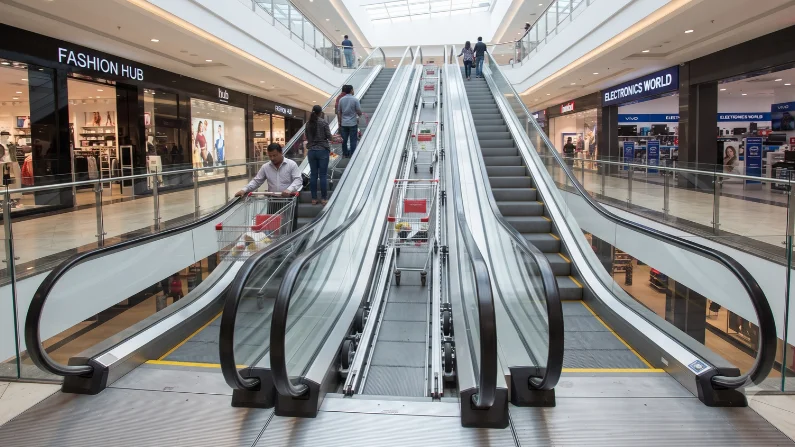
Escalator for grocery cart in Dubai searches have grown alongside the emirate’s multi-level retail expansion – large-format supermarkets, hypermarkets inside mall developments, and mixed-use retail podiums increasingly place grocery sections on upper floors rather than at street level.
For developers and mall operators, this creates a real design requirement: without dedicated cart transport, upper-floor grocery retail becomes significantly less convenient for shoppers, directly affecting foot traffic and dwell time.
Cart Escalator vs Standard Passenger Escalator: Key Differences
A cart escalator isn’t simply a passenger escalator with a wider step – the structural and mechanical differences run deeper, and understanding them matters for anyone specifying equipment during the design phase:
|
Factor |
Standard Passenger Escalator |
Cart Escalator |
|
Step surface |
Flat tread |
Rung-grooved tread to seat cart wheels |
|
Typical incline angle |
Up to 30°–35° |
Shallower end of the same range, optimized for cart stability |
|
Load consideration |
Passenger weight distributed across the step |
Concentrated wheel-point loading requiring reinforced step structure |
|
Safety systems |
Standard handrail and comb-plate sensors |
Additional entry gate, height limiter, and reinforced guardrails |
|
Synchronization |
Standalone unit |
Often installed synchronized alongside a pedestrian escalator, running as a paired system |
Specification Considerations for Escalator Cart Systems
Specifying an escalator cart system requires input earlier in the design process than most equipment decisions, since it affects floor plate layout, not just equipment selection:
💥 Confirm cart dimensions and wheel type used by the retail tenant before finalizing step width and rung spacing
💥 Coordinate incline angle with floor-to-floor height – a shallower angle for cart stability requires more horizontal run length than a standard passenger unit
💥 Plan for paired installation – most cart escalator installations run alongside a standard pedestrian escalator, so both units need to be planned as a combined footprint from the outset.
Planning Space for an Escalator for Trolley Movement
An escalator for trolley transport takes up significantly more floor area than a standard passenger unit once you account for the paired-escalator configuration and shallower incline angle.
This is a common oversight in early-stage retail design – architects sizing the atrium or escalator void based on pedestrian-only equipment often find the footprint doesn’t accommodate a cart-transport pairing once the retail tenant’s requirements are finalized later in the project.
Customer Experience: Why Grocery Carts Shouldn't Share a Passenger Elevator
Using a standard passenger elevator to move grocery carts between floors may appear convenient, but it can create a less comfortable experience when the elevator is busy.
Reduced Cabin Space – A loaded grocery trolley occupies considerable floor area, reducing the space available for other passengers.
💥Lower Passenger Comfort – Passengers may have to stand close to carts, groceries and other belongings, particularly when the elevator is crowded.
💥Slower Boarding and Exit – Large trolleys require more manoeuvring space, which can make entering and leaving the elevator slower.
💥Longer Waiting Times – When carts take up substantial cabin space, fewer passengers can travel in each trip, potentially increasing waiting during peak shopping hours.
💥More Congestion at Landings – Multiple trolley users entering or exiting at the same time can create congestion around elevator doors and retail circulation areas.
💥Less Efficient Passenger Movement – A passenger elevator serving both regular shoppers and frequent trolley traffic may struggle to provide the smooth circulation expected in a busy supermarket or mall.
Standards and Certification for Escalator Trolley Systems
An escalator trolley system in a UAE retail development should carry recognized international certification- CE marking and compliance with European escalator safety standards are the benchmarks most UAE developers and consultants specify, alongside meeting local Civil Defence requirements for public-access equipment in retail environments.
Where Trolley on Escalator Systems Make the Most Sense
A trolley on escalator installation isn’t universally necessary – it’s a specific design decision suited to particular retail formats:
- Multi-level supermarkets and hypermarkets where grocery sections span more than one floor
- Mall developments with anchor grocery tenants on upper retail levels
- Mixed-use retail podiums where parking or arrival levels sit below the main retail floor
Installation Timeline and Project Coordination
A trolley escalator installation needs to be coordinated with the broader construction and MEP program, not treated as a late-stage equipment addition:
- Early design coordination – incline angle and floor plate allowance confirmed during architectural design
- Structural coordination – floor openings and support structure planned alongside the building’s core structural design
- Manufacturing and supply – units built to the confirmed specification
- Installation and commissioning – completed alongside the broader escalator and MEP installation program, with full safety testing before handover
Conclusion
Choosing the right escalator for grocery cart in UAE retail projects requires careful planning around safety, load capacity, floor space, and customer convenience. From selecting a dedicated trolley transport system to coordinating structural requirements and certification, early specification helps avoid costly design changes and supports smoother movement between retail floors. Altivex Elevators can help you explore suitable vertical transportation solutions for your project. Contact our team to discuss your requirements and request a quote.
FAQ
Can a standard escalator be modified to carry grocery carts, or does it require a dedicated unit?
A dedicated unit is required. The rung-grooved step surface, reinforced structure, and cart-specific safety systems are built into the escalator’s design and cannot be retrofitted onto a standard passenger unit.
Does a cart escalator need to be paired with a standard pedestrian escalator?
In most retail installations, yes – cart escalators typically run synchronized alongside a standard passenger escalator, allowing shoppers without a cart to use the pedestrian unit while cart-carrying customers use the dedicated lane.
How much additional floor space does a cart escalator installation require compared to a standard unit?
Space requirements depend on the specific incline angle and floor-to-floor height, but the paired-installation format and shallower incline angle typically require a larger combined footprint than a single passenger escalator alone – this should be confirmed during early design, not after floor plates are finalized.
What certification should a cart escalator hold for a UAE retail project?
CE certification and compliance with European escalator safety standards are the common benchmark specified by UAE developers and consultants, alongside meeting local Civil Defence requirements for public retail environments.
Is a cart escalator suitable for every multi-level supermarket?
Not necessarily. It’s most relevant where a significant grocery retail area sits above the entry level – smaller formats or single-level layouts often don’t justify the additional structural and space requirements.
Our Services
Elevator Manufacturing | Elevator Supply | Elevator Installation
Ready to Install Our Elevators?
Book a free consultation with Altivex today!
Our Specialities!
Trusted world wide| Free Installation | EU Standards | 5-Year Warranty | Fast 14-Day Delivery — Suitable for Residential, Commercial & Industrial Applications