
Why Elevator Counterweights Matter for Performance and Safety | Altivex Elevators

In elevators using the traction system, the elevator counterweight acts as a hefty weight that operates in the reverse direction to the lift. It helps in balancing the lift along with some of the loads inside it to make the movement of the lift less difficult. Although it does not act as a safety measure, it still has a very important role to play in the operation of the elevator. The following guide will tell you all about it.
What Is a Counterweight in an Elevator?
If you’re wondering what a counterweight in an elevator is, think of a seesaw. The elevator car sits on one side and the counterweight on the other, connected by ropes or belts over a drive sheave.
- Position – In a traction elevator, it usually runs in the shaft alongside the car, on guide rails.
- Connection – It is linked to the car through the suspension system.
- Movement – When the car goes up, the counterweight goes down, and the other way round.
- Weight – Its mass is chosen in relation to the car and its intended load.
Not every lift uses a conventional counterweight. Some designs, such as certain hydraulic lifts, work differently, so the configuration always depends on the elevator type.
What Is the Purpose of a Counterweight in an Elevator?
The purpose of a counterweight in an elevator comes down to a few jobs:
Balances the car and load
It offsets the weight of the car and part of its passenger load, depending on the system design.
Reduces the drive force needed
With the weight balanced, the motor doesn’t have to lift the whole car alone.
Supports efficient operation
A well-matched counterweight can reduce the work asked of the drive system. Actual energy use also depends on the motor, drive, controls and how the lift is used.
Supports smooth movement
It works with the traction system to move the car, but it doesn’t guarantee a smooth ride by itself.
What Role Does the Counterweight Play in Safety?
The counterweight is part of how a traction elevator is designed to operate, but it is not a fall-prevention device. Passenger safety comes from the whole system working together:
🚩 Correct sizing and installation – The counterweight must suit the elevator.
🚩 Suitable suspension and traction – These components carry the load.
🚩 Independent safety components – Brakes, overspeed governors and safety gears, where applicable, do the safety work.
🚩 Qualified inspection and maintenance – Done by trained elevator technicians.
How Does an Elevator Counterweight Affect Performance?
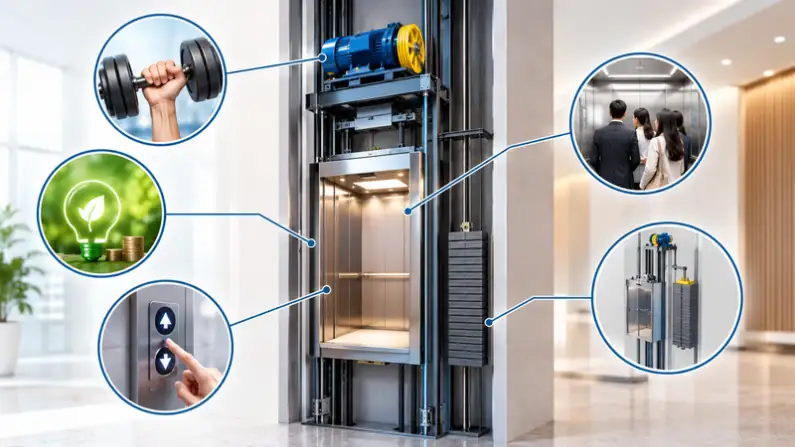
🚩 Motor load – Improved balance means lower required strength to move the elevator.
🚩 Energy consumption – Balance between elevator car and the load influences energy consumption.
🚩 Quality of operation – Appropriate configuration and adjustment help to achieve steady performance.
🚩 Working conditions – Loads of passengers affect how the elevator functions.
🚩 System design – Counterweight should be appropriate for the lift.
Elevator’s performance is dependent on the entire system and not on its components.
How Does an Elevator Counterweight System Work?
A counterweight elevator system works on a simple principle:
Connected
The car and counterweight are joined through the suspension system.
Opposite movement
When the car moves one way, the counterweight moves the other.
Controlled by the drive
Prevents the elevator from operating when the capacity limit for passengers has been exceeded.
Balance matters
The balance between the car, passengers and counterweight decides how much force is needed.
Control and braking
The control and braking systems handle normal running and stopping.
Counterweights in Residential and Commercial Buildings
Counterweight design matters across property types, but the requirements are not the same everywhere:
- Villas and private lifts – Lower capacity and lighter daily use.
- Apartment buildings – More residents and regular traffic.
- Hotels and offices – Heavier passenger demand through the day.
- Shopping centres and busy properties – High traffic and frequent journeys.
Capacity, building height, passenger demand and system design all shape the engineering. Not every UAE building uses the same counterweight setup. Good elevator design takes all this into account from the start.
How Counterweights Are Inspected and Maintained
- Inspection – Accessible components are checked according to manufacturer requirements.
- Suspension and traction – Related components are reviewed.
- Unusual behaviour – Technicians look for changes in how the lift operates.
- Schedules and rules – Follow the manufacturer’s maintenance schedule and applicable local requirements.
- Qualified technicians only – Inspection, adjustment and repair should be done by trained professionals using approved procedures.
Choosing the Right Elevator System
Look at the full system, not just one component:
- Building type and height
- Passenger capacity
- Expected traffic
- Drive and control technology
- Energy performance
- Maintenance requirements
- Project specifications and safety requirements
Getting elevator installation and customisation planned together helps avoid problems later.
Conclusion
The counterweight of an elevator counterbalances the car and has an influence on the effort put by the drive system to move the elevator. This aspect influences the efficiency of the lift, but safety is dependent on the entire elevator system, including the safety devices that work independently and the proper installation and maintenance of the lift system. Knowledge about the working of a counterweight elevator system can help you ask the right questions about the elevator choice. Explore our passenger elevators in the UAE to find the right fit.
FAQ
1. Define an elevator counterweight.
An elevator counterweight is a weight moving in the opposite direction to the car in most traction elevators.
2. Why is a counterweight needed in an elevator?
To balance the elevator car and load to minimize the force that the drive will need.
3. Explain how an elevator counterweight system operates.
The elevator car and counterweight are connected through a suspension system, moving in the opposite direction from each other, and the drive and control system handle the movements and stops.
4. Do all elevators have a counterweight?
Not all. Most traction elevators have them, while others, including some hydraulic elevators, don’t.
Our Services
Elevator Manufacturing | Elevator Supply | Elevator Installation
Ready to Install Our Elevators?
Book a free consultation with Altivex today!
Our Specialities!
Trusted world wide| Free Installation | EU Standards | 5-Year Warranty | Fast 14-Day Delivery — Suitable for Residential, Commercial & Industrial Applications